Abrupt changes of course are perhaps the most challenging moments for any writer, yet they also offer the writer a chance to view his surroundings in a different, and perhaps more compelling, light. Two such changes have snapped the narrative in this blog’s area of focus in the past ten days—the halting of the Feyenoord City project and the Dutch government’s decision to ban supporters from matches until at least the beginning of December. Only the first of these reversals was known when your writer attended Feyenoord’s match against AZ on 7 November; this piece is a reflection on both.
I got off the train bringing supporters from the centre of Rotterdam to the neighbourhoods south of the Maas one stop earlier than I usually do, to walk the last bit towards De Kuip, and past the site where Feyenoord City had been set to be built. The first part of the walk to the ground passed a rather dilapidated-looking petrol station and a row of warehouses between the railway line and the river, with the floodlights of De Kuip just in view, before reaching a car park hugging the banks of the Maas. It was here that the new ground, and the flat blocks and hospitality which were to accompany it, would have towered over the water, turning this rundown area into one of Rotterdam’s most modern. Such a view was difficult to picture on a chilly November day, with the gusts whipping off the Maas under a pale afternoon sun.

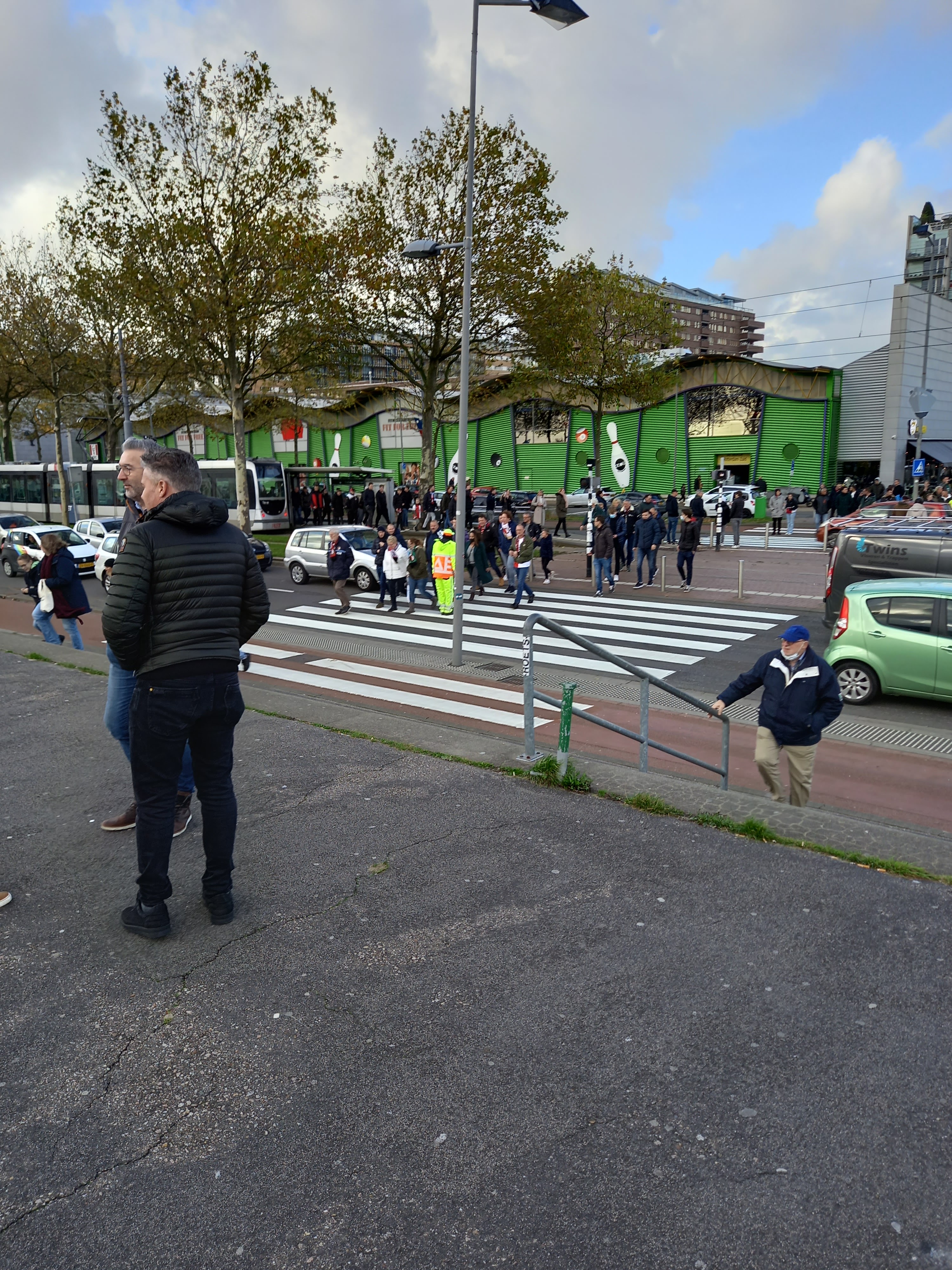
I made my way on to the stadium through a small neighbourhood, full of chain restaurants and pubs with outdoor terraces catering to the match-going crowd, almost all of which were full with 90 minutes to go until kick-off. Trams halted in front of De Kuip, depositing their haul of supporters in scarves and coats. Once inside the ground, one was reminded that today’s match was dedicated to the Sophia Kinderziekenhuis by the presence of volunteers asking for donations just inside the stadium gates; almost all those filtering in stopped to donate something, even if, as in my case, all they had on them was a 50-cent coin. ‘All little bits help’, said the man in whose jar I dropped my coin. The supporters’ bond with the children’s hospital was further emphasised just before kick-off, when a massive banner with the text ‘You’ll Never Walk Alone’ was unfurled. It’s that sort of moving gesture which best illustrates the societal role played by Feyenoord, a club which proclaims itself ‘accessible for all, in the middle of society’.
The match itself was the first fixture against another top opponent to be played with fans in nearly two years’ time, and one with a tense undercurrent for both clubs. AZ, traditionally a mid-table club from the small city of Alkmaar north of Amsterdam, have finished above Feyenoord in three of the last four seasons, while Feyenoord’s (successful) pursuit of then-AZ manager Arne Slot led to Slot getting the sack at the end of 2020. For the first time since supporters were allowed back into stadiums, there was the sort of nervously excited atmosphere which comes about when two sides of roughly equal strength face one another, an atmosphere strengthened by the near absence of any empty seats in the ground, both the home and away ends packed full. Not for the first time in the Eredivisie this season, supporters also had a direct impact on the rhythm of the match, with play being suspended just before half-time as a mishmash of Red Bull cans and half-full cups of beer were chucked in the direction of AZ’s Dutch international left-back Owen Wijndal. When Wijndal cheekily threw a can back at the fans behind the goal, the supporters responded by booming out a chant questioning the profession performed by the player’s mother. Civilised it was not, but it is that spontaneous character of the crowd which makes football the entrancing spectacle it is, and it is sobering to think that we face a potentially prolonged period without supporters once again in the Netherlands.
An entertaining match ended in the best possible manner, as Cyriel Dessers struck in the second minute of injury time to push Feyenoord up to third spot, ten points clear of AZ. The mood was buoyant at the stadium’s exits and in the train heading back to Rotterdam Centraal, from where supporters would disperse to all four corners of the Netherlands, all expecting to be back in a fortnight for the match against PEC Zwolle. Yet Dutch stadiums are shut, in contrast to almost all our neighbours across Europe, and the fear now is that they won’t be open again until well into 2022.
 Inthehalfspace